

In 2023, Ethan Mollick, Karim Lakhani and colleagues published a really interesting paper on AI tasks that highlighted a new concept called “The Jagged Frontier.”
The core insight is deceptively simple but profoundly important: AI capabilities don’t form a smooth, predictable boundary. Instead, they create a jagged frontier where some tasks are remarkably easy for AI while others—seemingly similar in difficulty—lie completely outside its capabilities. This jaggedness makes it nearly impossible to predict what AI can and cannot do based on intuition alone.
The researchers tested this with 758 consultants at Boston Consulting Group, assigning them realistic business tasks. For work inside the frontier, the results were stunning: consultants using GPT-4 completed 12% more tasks, worked 25% faster, and produced work rated over 40% higher in quality. Even more interesting, the performance boost was largest for below-average performers, whose quality jumped 43% compared to just 17% for top performers
.At Neurometric, we’ve shown this jagged frontier exists in a technical format as well. Our research, highlighted here, indicates that choosing the right thinking algorithm along with the right model can vary widely per task. And like the previously mentioned jagged frontier—it’s difficult to predict the outcome in advance. Sometimes “best of n” wins over “beam search” on a task for one model while the reverse is true for a similar model.
This has significant implications if you are building multi-model AI systems. It means you can’t simply default to a single inference strategy and expect optimal results across your workload. The performance landscape is too irregular, too task-dependent, and too model-specific.
Consider what this looks like in production. Your customer service application might handle routine queries perfectly with a small model using standard sampling. But complex technical questions could benefit from the same model using chain-of-thought prompting, while sentiment-sensitive cases might need a different model entirely with majority voting across multiple responses. The optimal configuration changes not just by model, but by the thinking algorithm you pair with it.
This creates a measurement problem that most enterprises aren’t equipped to solve. Unlike the BCG consultants who knew they were navigating uncertain AI capabilities, production systems fail silently. You won’t know your customer service bot gave a 40% worse answer because you used the wrong thinking algorithm for that specific query type—you’ll just see churn three months later.
The traditional response to uncertainty is testing, but the combinatorial explosion makes exhaustive testing impractical. With multiple models, multiple thinking algorithms, and thousands of task types, you’re looking at millions of possible configurations. Meanwhile, the frontier keeps shifting as new models release and your use cases evolve.
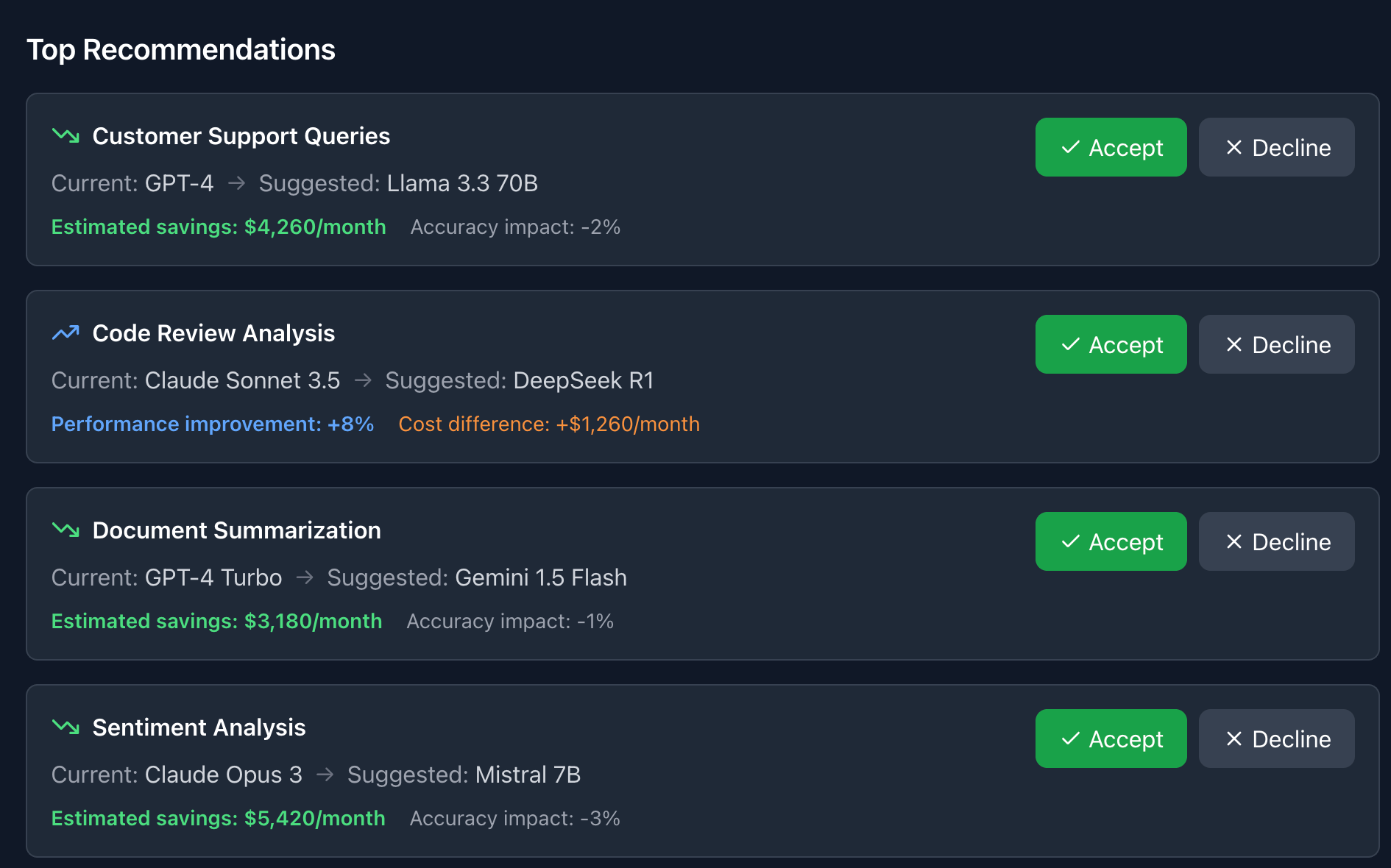
This is precisely why Neurometric exists. By continuously measuring what actually works across model-algorithm combinations and routing intelligently based on real performance data, you can navigate the jagged frontier systematically rather than guessing. You get the 40% quality improvements where they matter, the 60-80% cost reductions where they’re possible, and the reliability to actually ship to production.
The jagged frontier isn’t going away—it’s getting more complex as both models and inference techniques proliferate. The question isn’t whether to navigate it, but whether you’ll do so with data or intuition.