

This is the final post in our series on the AI maturity journey. Part 1, Part 2, Part 3, Part 4.
What if the biggest bottleneck in AI isn’t the capability of the models, but the speed of human decision-making?
In 2026, even the most sophisticated Stage 5 organizations—those managing a dozen models with surgical precision—still rely on a human in the loop to evaluate new releases, adjust routing tables, and tweak configurations. But as the pace of model innovation accelerates, this human-centric approach is becoming a liability. The vision for Stage 6 is a paradigm shift where AI manages AI. Here, the infrastructure layer itself becomes intelligent, continuously self-optimizing without human intervention for routine decisions.
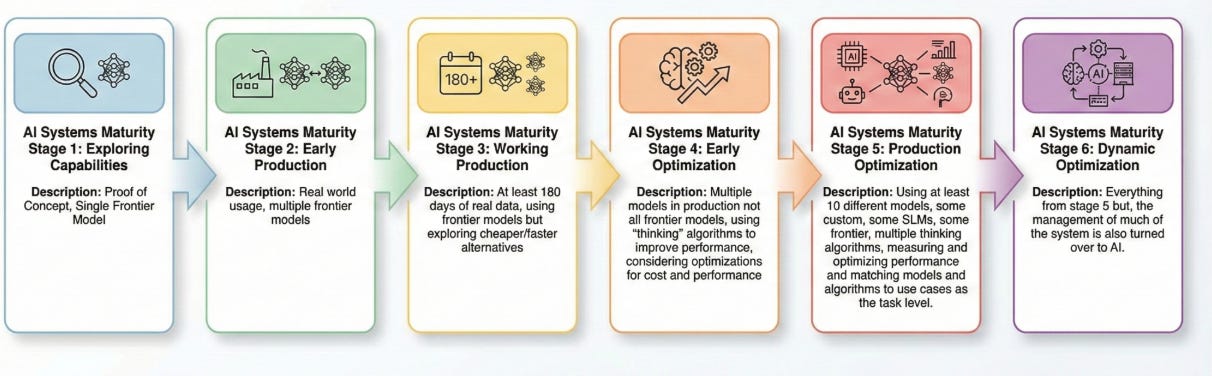
The leading companies aren’t just optimizing their AI systems. They are building AI systems that optimize themselves. This is the future of AI infrastructure management.
Where We Are Now—The Limits of Stage 5
Stage 5 is a significant achievement. It represents an organization that has mastered a portfolio of 10+ models, including frontier LLMs, SLMs, and custom fine-tuned weights. These companies treat optimization as a core operational discipline.
However, Stage 5 still possesses a fundamental “human bottleneck.” Engineers must still interpret dashboards to decide when a task should move from GPT-4o to a distilled Llama-4 variant. They must manually benchmark every new model release against their specific production data—a process that can take weeks.
In an environment where model capabilities improve weekly, a human evaluation cycle that takes months is a recipe for obsolescence. The optimization surface has become too complex for human intuition. Best practices established on Tuesday are often outdated by Friday. The question facing Stage 5 organizations is no longer “How do we optimize?” but rather “How do we optimize a system that is more complex than a human can manage in real-time?”
The Stage 6 Vision—AI Managing AI
In Stage 6, the infrastructure layer becomes an active participant in its own management. Routing, model selection, reasoning depth, and cost-quality tradeoffs are managed by AI agents operating continuously.
What Stage 6 Looks Like in Practice:
Self-Optimizing Routing: Incoming tasks are classified in real-time by a specialized “router” model. Decisions aren’t based on static rules but on dynamic performance data, current latency across providers, and real-time cost-per-token metrics.
Automated Model Evaluation: When a new model is released, the system automatically runs it against production task samples in a shadow environment. It surfaces performance deltas and suggests promotion or demotion recommendations before a human engineer even reads the release notes.
Dynamic Thinking Allocation: Reasoning depth (e.g., “Thinking” configurations) is adjusted on a per-request basis. The system learns which specific queries benefit from extended “Chain-of-Thought” processing versus those where a quick, low-cost response is sufficient.
Continuous Rebalancing: The portfolio mix is adjusted based on live performance data. If a provider experiences a momentary degradation in quality, the system routes around it automatically.
In this stage, the human role undergoes a profound evolution: from operators making decisions to strategists setting constraints. Humans define the objectives (e.g., “Max latency of 200ms with a quality floor of 92%”), and the AI figures out the most efficient way to achieve them.
What Makes Stage 6 Possible
We are reaching a technological convergence that makes this autonomous layer viable. First, meta-learning for routing has matured; we now have models specifically trained to predict which other models will perform best on a given task.
Second, our evaluation infrastructure has moved beyond human labeling. Programmatic quality measurement—using “LLM-as-a-judge” patterns and automated regression testing—allows for the high-frequency feedback loops that self-optimization requires.
Finally, the diversity of the model landscape has reached a critical mass. When you only had two models to choose from, a human could manage the choice. With dozens of viable models, varying from 1B to 1T+ parameters, the mathematical “tradeoff surface” is now so vast that only an algorithmic approach can navigate it efficiently.
What the Leaders Are Building Toward
The frontier of AI infrastructure is moving toward four core components:
The Intelligent Gateway: Every request flows through a millisecond-latency optimization layer that classifies, routes, and configures the request dynamically.
The Model Evaluation Factory: Automated pipelines that treat model releases like software updates, running them through a gauntlet of production-representative workloads automatically.
The Continuous Experimentation Engine: A small percentage of production traffic is always testing alternative models or configurations. Winning variations are promoted automatically; losing ones are deprecated without a single Jira ticket being created.
The Cost-Quality Optimizer: Real-time visibility that enforces budget constraints dynamically. If tokens get too expensive, the system shifts more traffic to SLMs to maintain the margin.
This shift creates a competitive moat. An organization with a self-optimizing system improves its unit economics and performance every day, whereas a human-managed organization only improves when its engineers find the time to perform a manual audit.
The Path from Here to There
If you are currently a Stage 5 organization, the transition to Stage 6 begins with a few foundational steps:
Invest in Evaluation Automation: Programmatic quality measurement is the “eyes” of a Stage 6 system. If you still rely on human intuition to tell if a model is “working,” you cannot scale.
Build Data Feedback Loops: Ensure every routing decision, model response, and quality signal is logged in a way that is “machine-learnable.” Your future optimization agents will train on this history.
Experiment with Meta-Routing: Start small. Let an AI system suggest routing changes for 5% of your traffic, then graduate to automated implementation with human oversight once trust is established.
Define Objectives Formally: Move from “vague goals” to “formal constraints.” Stage 6 requires explicit parameters for cost, quality, and latency that a system can optimize toward mathematically.
Closing
Stage 6 isn’t science fiction—it is the logical endpoint of the AI optimization journey. The companies that reach this stage first will operate at efficiency levels that competitors simply cannot match through manual human effort.
This is the ultimate competitive advantage: building an infrastructure that gets better faster than your competitors can copy. The question for every AI leader in 2026 is simple: Are you building a system that requires more people as it grows, or are you building a system that learns to manage itself?
The future of AI infrastructure management is AI. The only question is who gets there first. Reach out if you think Neurometric can help.