

Training a custom language model has always meant making a long sequence of consequential decisions before you write a single line of fine-tuning code: which base model fits the task, which training harness to use, how to generate quality training data without introducing hallucinations, how to evaluate the result. Get any of those wrong and you’re starting over.
We built the auto-SLM generator to eliminate that sequence entirely.
At Neurometric, because we evaluate models on task level data and ignore larger benchmarks, we have a very fine grained view of what base model SLMs are best for what tasks. That’s part of the secret sauce behind our new auto SLM tool.
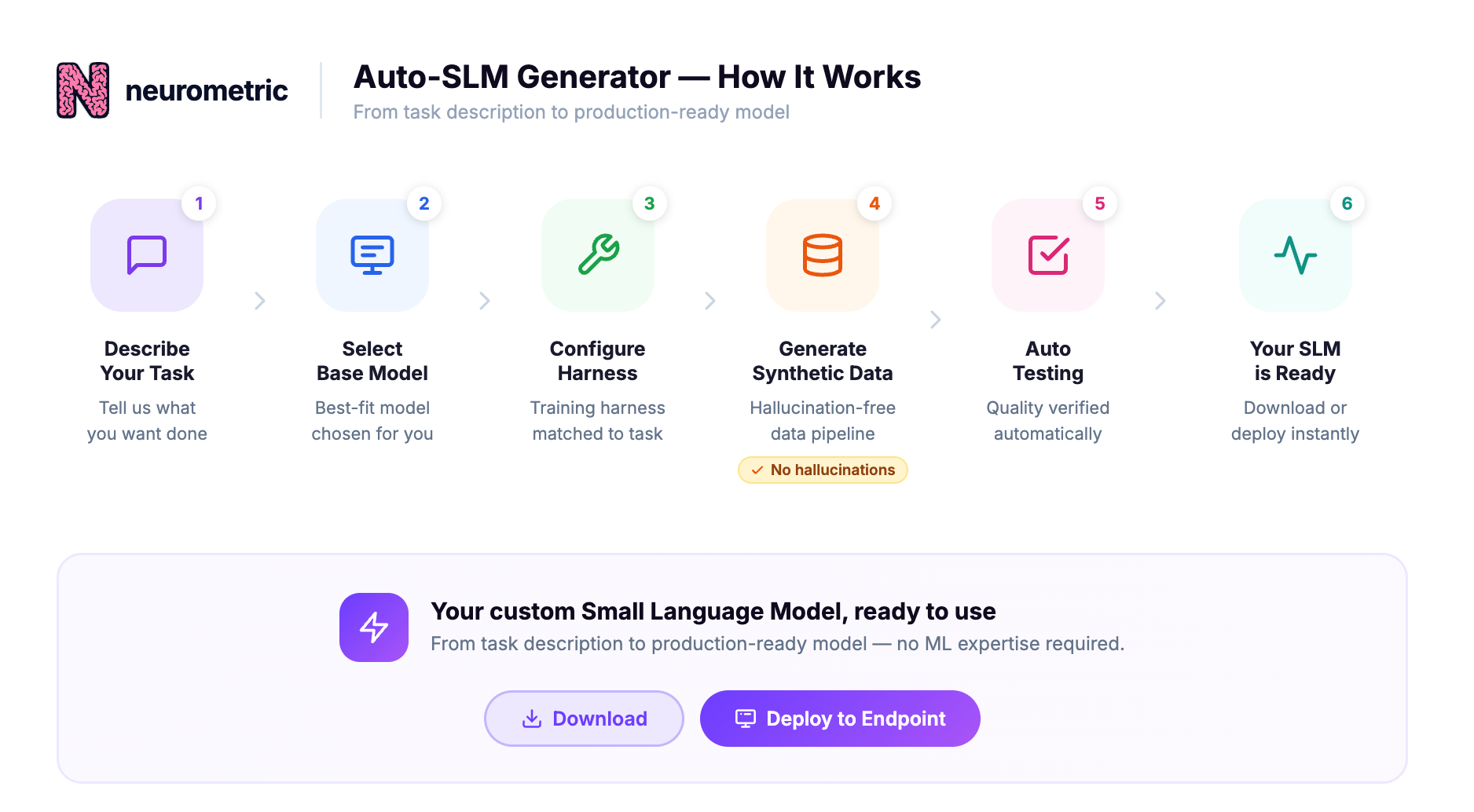
How It Works
Step 1: Describe the task. You write a plain-language description of what you want the model to do — classify, extract, rewrite, route, score, whatever. No schema required, no examples needed upfront.
Step 2: Base model selection. Rather than handing you a dropdown of model families and asking you to guess, we select the base model for you. We match task type, expected input/output size, latency requirements, and deployment constraints against our library of tested base models. The choice is deterministic and documented, not a black box.
Step 3: Harness configuration. The training harness — how the model sees examples, what the loss function is optimizing for, how few-shot context is structured — matters as much as the base model. We configure this automatically based on the task class we’ve inferred.
Step 4: Synthetic data generation. This is where most custom model pipelines break down. Generating training data with a large frontier model tends to bake in hallucinations: the generator invents facts, drifts from the task schema, or produces outputs that are internally consistent but wrong. We use a constrained generation approach that grounds every synthetic example against a verifiable source — the model cannot generate a claim it cannot source. The result is a training set that’s diverse without being fabricated.
Step 5: Automated testing. Before you see results, the model runs through a task-specific evaluation suite. We measure not just accuracy but calibration, edge-case behavior, and consistency across rephrased inputs. If it doesn’t pass, we iterate internally — you don’t debug it, we do.
Step 6: Download or deploy. Once the model clears evaluation, you can pull it as a standard model artifact or deploy it directly to a Neurometric-hosted endpoint, where billing is per-task rather than per-token.
Why We Built This
The bottleneck in adopting SLMs has never been the inference cost — it’s been the cost of getting a reliable model built in the first place. The auto-SLM generator removes that bottleneck. Describe the task, get a model that does it. That’s the whole thing.
We’re opening beta access now. If you have a task in mind, email slms@neurometric.ai.