

Not every AI task requires the same level of precision. That sounds obvious, but most teams still route every query to the biggest model they can afford—then wonder why their inference bills keep climbing.
Models are particularly bad at times series data, so we wanted to run an experiment and see what tradeoffs you may want to make to balance cost, accuracy, and latency on this type of task. We ran our optimization system on CRM-Arena’s “monthly trend analysis” task to see what happens when you actually test the tradeoffs. The task assesses an AI agent’s ability to query time-series data—sales figures, case volumes, structured records—and identify or summarize trends on a monthly basis. It’s a common customer service scenario requiring database querying and numerical computation.
A sample query looks like this: “Is there a particular month in the past 10 months where the number of support cases significantly exceeds those of other months? The associated product Id is 01tWt000006hVJdIAM. Return only the month name.”
Simple enough. But when we tested twelve different model configurations across multiple inference strategies, the results revealed why blanket model selection is costing enterprises millions.
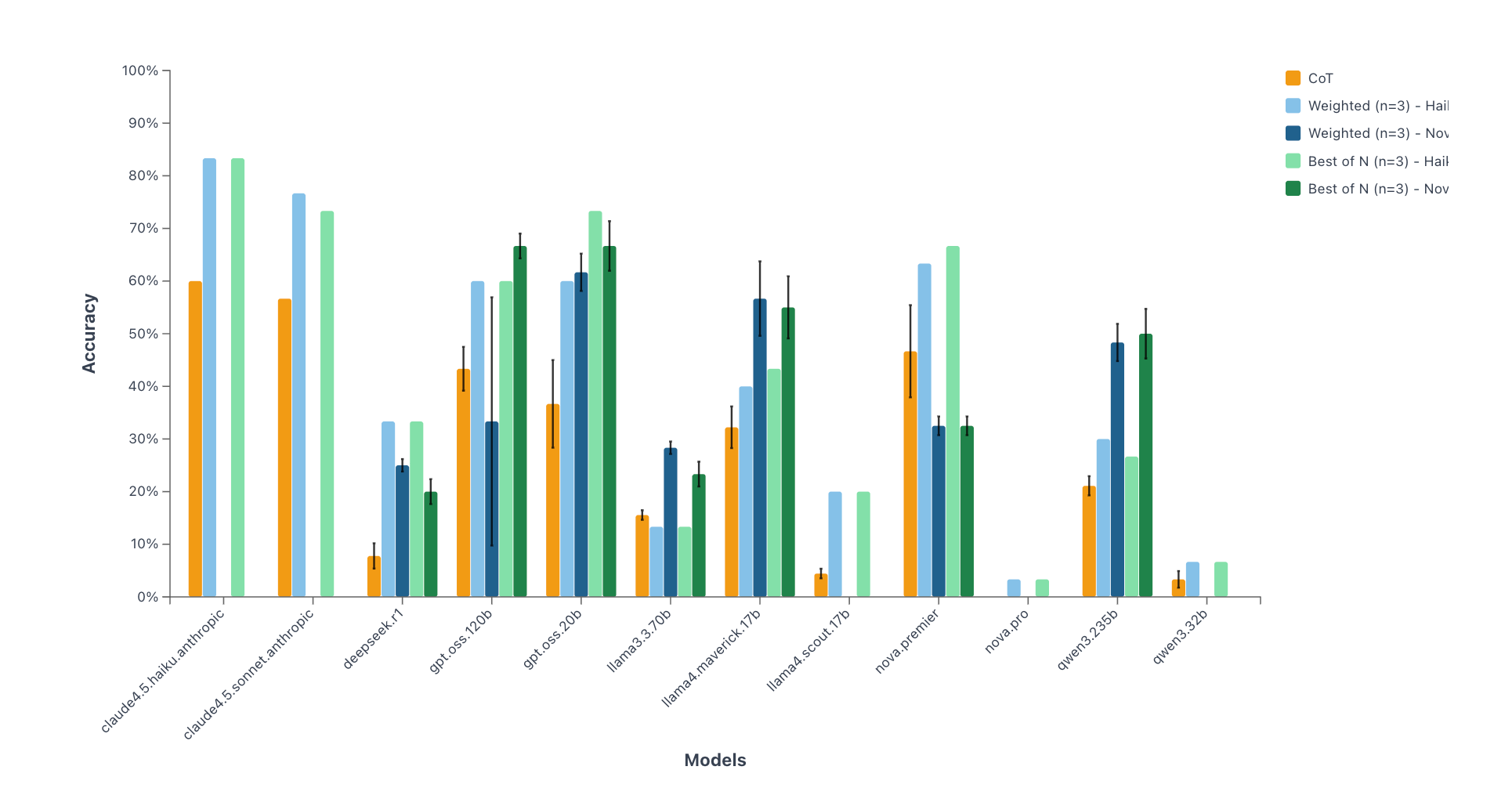
The accuracy leader: Claude 4.5 Haiku with Best-of-N (N=3) hit 83.3% accuracy. It cost $0.11 per run and completed in 25.8 seconds. For high-stakes trend analysis where errors mean missed revenue signals or misallocated support resources, that’s your benchmark.
The cost leader: GPT-OSS-20B with the same Best-of-N strategy achieved 73% accuracy—a 10-point drop—but cost just $0.01 per run. That’s a 90% cost reduction. The catch? Latency jumps to 107 seconds.
So how do you choose?
Start with the stakes. If this trend analysis feeds a board presentation or triggers automated staffing decisions, the 10-point accuracy gap matters. If it’s surfacing preliminary insights for a human analyst to verify, 73% might be perfectly acceptable—especially at one-tenth the cost.
Factor in volume. At 100 queries per day, the difference is $10 versus $1. At 10,000 queries, it’s $1,100 versus $100 daily. The 90% savings compounds fast.
Consider latency tolerance. 25 seconds is slow, but 107 seconds is even slower. Does either work for a real time dashboard? If not maybe a fine tuned SLM is a better approach. However if you are batch processing overnight reports, neither latency is an issue. So define your requirements and remember your architecture should reflect your actual workflow, not theoretical best practices.
Don’t forget the algorithm. Notice that raw Chain-of-Thought prompting underperformed Best-of-N across nearly every model. The inference strategy you wrap around the model matters as much as the model itself.
Monthly trend analysis is just one example—a relatively simple time-series problem. The principle holds across use cases: there’s no universally “best” model, only the best model for your specific accuracy requirements, cost constraints, and latency tolerance.
The teams winning at AI infrastructure aren’t the ones with the biggest models. They’re the ones who’ve learned to match the right system to the right task.