

This is a series. Post 1, Post 2.
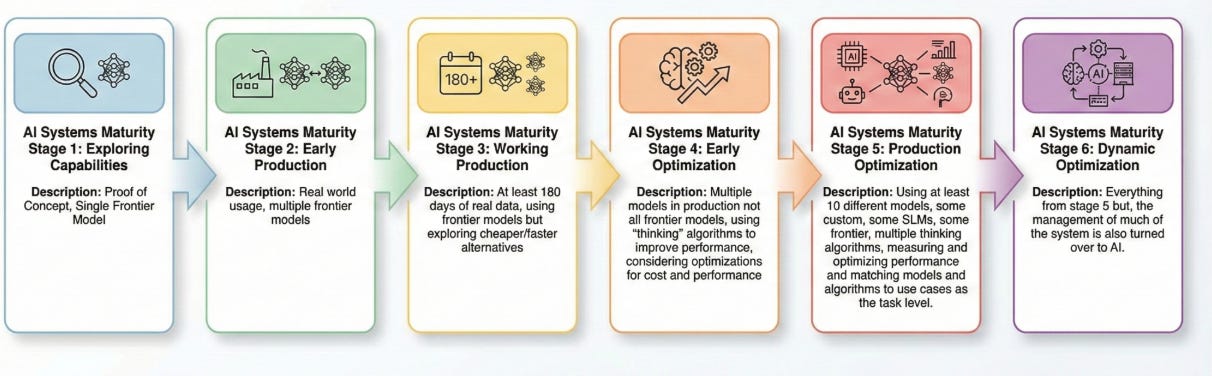
If you are in Stage 3 of your AI journey, your company is well ahead of most. Many organizations reach a comfortable plateau in Stage 3. Their AI is stable, users are happy, and the “Working Production” label feels like a victory. Yet, they remain locked in a single-model comfort zone, routing every query—from simple data formatting to complex reasoning—through a single, expensive frontier model. The inflection point occurs when curiosity about alternatives turns into operational execution. Stage 4 is where you stop treating AI as a monolithic service and start treating it as a dynamic resource. It is the transition from “one model to rule them all” to a specialized, multi-model architecture where the right model is surgically matched to the right task, finally making AI economics work in your favor.
The Reality of Stage 3: The Benchmarking Plateau
By the time an organization reaches Stage 3, it has usually accumulated over 180 days of production data. The system is reliable, and the team likely has a sophisticated evaluation infrastructure that can run “shadow tests” on cheaper alternatives. However, despite having the data to prove that a smaller model could handle 40% of their traffic, most companies stall here. They are paralyzed by a fear of regression—the “what if” scenario where a smaller model misses a critical nuance that a frontier model would have caught.
This stage is defined by curiosity paired with extreme caution. While leadership might see the high API bills, the operational team often views optimization as a luxury or a risk rather than a necessity. According to 2026 industry data, while over 80% of enterprises have deployed GenAI APIs, only a fraction have moved beyond this single-model dependency. The uncomfortable truth is that you can run benchmarks indefinitely, but real optimization only begins when you actually pull the trigger and ship a multi-model architecture.
What Stage 4 Actually Looks Like: Strategic Deployment
Stage 4, or “Early Optimization,” is characterized by a fundamental shift in architecture. Instead of a direct line from user to frontier model, a “router” or “orchestrator” now sits in the middle. This system segments tasks in real-time: a simple sentiment analysis call goes to a lightning-fast Small Language Model (SLM), while a complex legal reasoning task is sent to a frontier model with extended thinking capabilities.
This stage also introduces the “thinking algorithm” unlock. Companies in Stage 4 recognize that model size isn’t the only lever for performance. By using test-time compute—essentially allowing a smaller model more “thinking time” to iterate on a problem—they can achieve results that previously required a model 14x larger. This creates a new three-dimensional optimization space: model size × reasoning time × cost. For the first time, the organization isn’t just asking which model is “best,” but which combination of model and compute is optimal for this specific task at this specific cost.
What Drives the Transition: The Forcing Functions
The move to Stage 4 is often accelerated by the sheer weight of production costs. As AI usage scales, aggregate spending often grows faster than the budget, forcing a move toward efficiency. Gartner forecasts that by the end of 2026, GenAI model spending will grow by 80.8%, a trajectory that is unsustainable for most companies without optimization.
Beyond cost, the market evolution of reasoning models (like the o1 and R1 series) provides options that didn’t exist a year ago. When shadow testing proves that these specialized models can match frontier performance for specific task tiers, the “benchmark confidence” finally outweighs the fear of regression. You know you are stuck in Stage 3 if your optimization efforts remain a research project rather than an operational priority. Stage 4 happens when the team is empowered to make model-swap decisions based on clear, data-driven thresholds of “good enough.”
Key Questions Before Making the Leap
Before transitioning to an optimized, multi-model environment, your organization must answer these critical questions:
On Deployment Readiness: Have we defined explicit quality thresholds for each task? Can our current infrastructure support routing different tasks to different models without increasing latency?
On Thinking Algorithms: Have we measured whether extended reasoning (test-time compute) actually improves smaller model performance for our specific datasets? Do we understand the tradeoff between a 2-second “fast” response and a 10-second “thinking” response for our users?
On Organizational Alignment: Who officially owns the “Model Selection” decision? Is the organization prepared to accept a 1–2% variance in quality if it results in a 70% reduction in cost?
On Measurement Infrastructure: Are we capable of measuring quality in real-time production, or are we still relying on static benchmarks? Do we have an automated feedback loop to catch regressions the moment a model swap happens?
On Strategic ROI: Are we tracking “Cost-per-Quality-Unit” as a primary KPI? How does this optimization effort affect our long-term competitive advantage versus just cutting costs?
Making the Move: Practical Steps
Transitioning to Stage 4 requires a tiered approach. First, segment your task portfolio. Tier 1 tasks (high-stakes, complex reasoning) stay on frontier models. Tier 3 tasks (routine, high-volume) are moved to SLMs immediately. The real battleground is Tier 2, where you implement thinking algorithms to see if a mid-tier model with extra reasoning time can displace a frontier model.
Once the tiers are defined, you must build the routing logic and production monitoring. Start by deploying your first non-frontier model on your highest-volume, lowest-risk task. This “easy win” builds the organizational trust needed for more aggressive optimizations. Finally, establish a repeatable “Model Addition Playbook.” The AI landscape changes monthly; Stage 4 organizations are built to swap, test, and deploy new models in days, not months.
In Summary
Stage 4 is where AI stops being an expensive experiment and starts being a professionally managed operational system. The multi-model future isn’t a theoretical vision—it is the only path to a sustainable AI strategy in an era where model costs are the primary bottleneck to scale. The companies that master task-level model matching and test-time compute will achieve a level of efficiency that single-model competitors simply cannot match. The question isn’t whether you will eventually reach this inflection point, but how much “frontier tax” you are willing to pay before you make the move. If you think Neurometric can be helpful on your AI maturity journey, please reach out.