

This is a series on the AI maturity journey. Post 1, Post 2. Post 3.
You’ve done the hard work of breaking the mono-model habit. Your team has moved beyond the “one LLM to rule them all” phase, and you’re likely seeing the benefits: costs are down, latency is stable, and you’re managing maybe three or four models. It feels like you’ve reached the summit.
But in reality, you’ve reached a plateau.
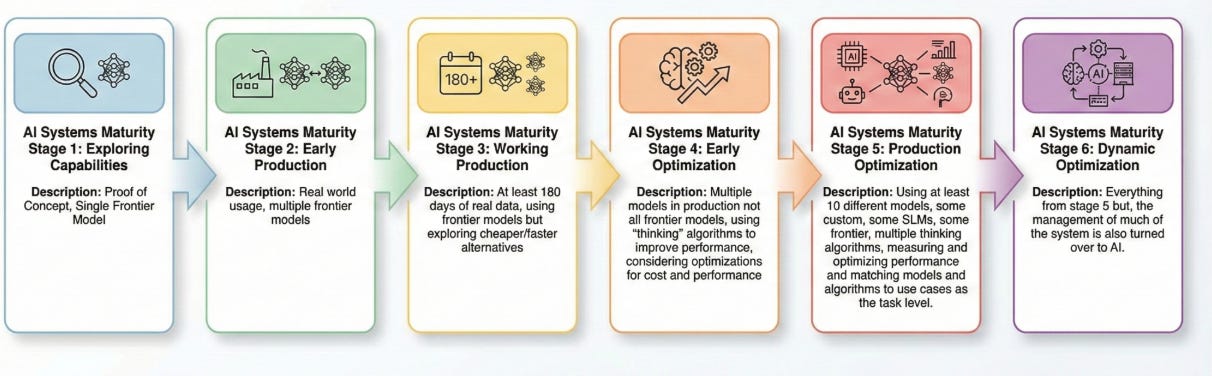
The “few models” plateau is a comfortable but dangerous place to stall. While your current setup is working, truly optimized AI systems in 2026 don’t just juggle a few APIs; they orchestrate 10+ models, each surgically matched to specific task profiles with precision thinking strategies. The leap from Early Optimization to Production Optimization isn’t about adding more models—it’s about building the discipline and infrastructure to manage model complexity as a core operational competency. This is where AI evolves from a collection of point solutions into a living, breathing system.
The Reality of Stage 4 (Early Optimization)
Stage 4 is where most sophisticated enterprises currently reside. At this level, you’ve demonstrated competence. You likely have a frontier model for complex reasoning, a mid-tier model for general tasks, and perhaps a Small Language Model (SLM) for high-speed summaries. Your routing is functional, and your cost savings are measurable.
However, Stage 4 optimization is fundamentally tactical and artisanal. Decisions about which model to use for which task are often made during the initial development phase and rarely revisited. The knowledge of why a specific model was chosen often lives in the heads of a few senior engineers rather than in a shared data repository.
Companies stall here because they hit a complexity ceiling. Managing four models feels manageable; managing twelve feels like an operational nightmare. The infrastructure built for a handful of models doesn’t scale, and because “meaningful” savings have already been achieved, the appetite for deeper optimization wanes. The uncomfortable truth? Stage 4 is a craft; Stage 5 is an industry.
What Stage 5 Actually Looks Like (Production Optimization)
In Stage 5, the mindset shifts from “selection” to Portfolio Management. You no longer view models as interchangeable software components, but as assets with varying risk-return profiles.
A Stage 5 portfolio typically includes:
Frontier Models: Reserved for high-stakes reasoning, novel edge cases, and complex decision-making.
Mid-Tier Models: The workhorses for routine complexity where cost and performance are balanced.
SLMs: Deployed for high-volume, well-defined tasks where millisecond latency and micro-cent costs are the priority.
Custom Models: Fine-tuned or distilled models that dominate specific domains (e.g., legal parsing or medical coding) where general models struggle.
In this stage, optimization is an ongoing operational function. You aren’t just asking “which model should we use?”—you are systematically measuring the cost-per-quality-unit across every task-model-algorithm combination. Measurement isn’t a post-mortem; it’s continuous. Automated regression detection ensures that a model update from a provider doesn’t silently degrade your specialized workflows, and A/B testing of model-task assignments is a standard, automated procedure.
What Drives the Transition
What pushes a company to leave the safety of Stage 4? Usually, it’s a combination of diminishing returns and scale. Once the “easy wins” of basic model routing are captured, further efficiency gains require a level of sophistication that manual tweaks can’t provide.
As task volume grows, even a 5% efficiency gain can represent millions in annual savings. Furthermore, the ROI of custom models becomes undeniable; when data proves that a distilled 7B parameter model can outperform a frontier model on a specific high-volume task, the “fine-tuning is too hard” excuse disappears.
Warning Signs You’re Stuck in Stage 4:
Model selection still requires a senior engineer’s “gut feeling.”
There is no repeatable process for evaluating and onboarding the weekly wave of new model releases.
“Thinking” algorithms (like chain-of-thought or tree-of-thoughts) are applied globally or not at all, rather than being matched to task depth.
Adding a new model to your stack feels like a major engineering project rather than a routine update.
Key Questions Before Making the Leap
Before you can graduate to Stage 5, you must evaluate your organizational and technical readiness. The transition requires more than just better code; it requires a shift in how you value AI assets.
On Portfolio Readiness
Do you have the data volume and quality to train or fine-tune effectively? More importantly, can your current infrastructure support 10+ models without creating operational chaos? If onboarding an 11th model requires significant manual refactoring, your infrastructure isn’t ready.
On Measurement Maturity
Are you measuring at the task-model-algorithm level? You need to know not just that a model is “fast,” but how its latency fluctuates when paired with specific reasoning depths. Is this data accessible to decision-makers, or is it locked in an engineer’s terminal?
On Organizational Structure
Who owns the model portfolio? In Stage 5, this is a strategic asset. You need dedicated capacity for optimization, not just “side-of-the-desk” attention from your DevOps team.
The Uncomfortable Question: Is your optimization approach truly scalable, or does it depend on heroic individual effort? If your lead AI architect went on vacation for a month, would your system continue to optimize itself, or would it stagnate?
Making the Move
Transitioning to Stage 5 requires a systematic roadmap. It isn’t a flip of a switch, but a series of architectural and cultural shifts.
Audit for Custom Model Candidates: Identify high-volume, domain-specific tasks where fine-tuning could outperform general-purpose models. Look for tasks with high “ground truth” clarity where you have ample training data.
Build Model Onboarding Infrastructure: Create a “plug-and-play” pipeline. Benchmarking a new model, shadow testing it against production traffic, and conducting a staged rollout should take days, not months.
Implement Multi-Dimensional Measurement: Move beyond simple “pass/fail” metrics. Track performance across the intersection of Task × Model × Thinking Configuration.
Establish Optimization as a Function: Assign clear ownership. This is an ongoing discipline. Just as you have a team for Cloud FinOps, you need a team for AI Model Ops.
Set Portfolio Targets: Manage your AI like an investment portfolio. Define goals: for instance, “Target 40% of traffic on distilled SLMs by Q3.”
Summary
Stage 5 is where model optimization transforms from a cost-saving exercise into a sustainable competitive advantage. Managing a dozen models across hundreds of tasks is complex—and that complexity is exactly what creates your moat.
The companies that build the capability to industrialize optimization will continuously improve their efficiency and performance while their competitors are still making manual, one-off decisions. In the era of the “model-of-the-week,” the winner isn’t the one who finds the best model; it’s the one who builds the best system for finding and deploying the best models at scale. At Neurometric we help you on this journey so please reach out if you want to chat.