

This is a series. Read Post 1.
There is a dangerous plateau that many organizations reach once they finally shepherd an AI initiative into production. The users are engaged, the leadership team is finally seeing the “magic” they were promised, and the system is generally stable. In this moment, the temptation is to breathe a sigh of relief and stop moving. But staying in this “Early Production” phase is a quiet trap. While the system works, it is often fundamentally inefficient. Recent data from 2025 suggests that up to 42% of AI projects will be eventually abandoned even after reaching production because they fail to reconcile their high operating costs with sustainable business value. The transition from Stage 2 to Stage 3 is the pivot from asking “Does it work?” to asking “Does it work efficiently?”
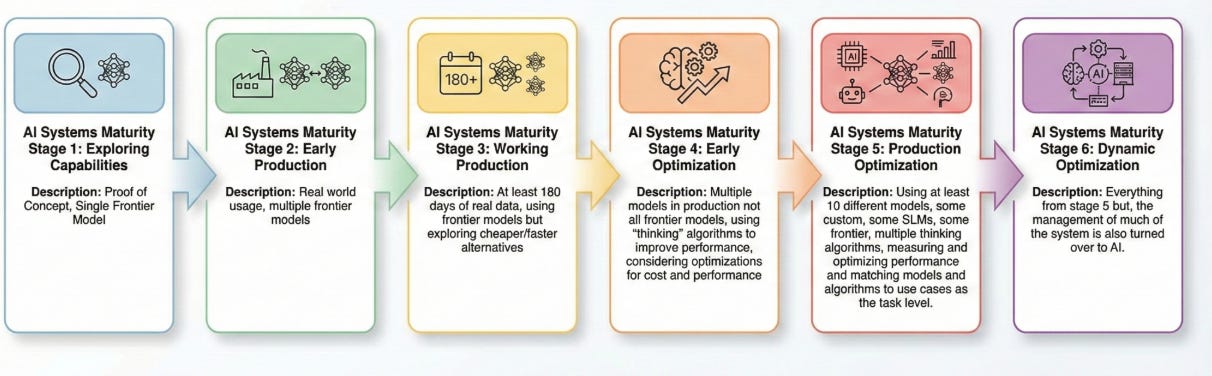
The Reality of Stage 2: Survival Mode
In Stage 2, your organization has successfully crossed the “chasm” from the lab to the real world. You have real users interacting with AI in actual workflows, and you likely have the measurable outcomes to prove it. However, this stage is characterized by a “survival” mindset. Most companies at this level default to a “frontier model for everything” strategy, leaning on the massive reasoning power of models like GPT-5 or Claude Opus because they are the safest bets for avoiding failure.
Because you are still in the early days of deployment, your data is limited. You haven’t yet seen how the system handles seasonal traffic spikes or how model drift affects your specific use case over six months. In Stage 2, you are essentially firefighting; the goal is uptime and reliability. You know the bills are high—Gartner’s 2026 forecast shows a staggering 80.8% growth in GenAI model spending—but you justify it as the necessary price of innovation. The “comfortable illusion” here is that because the users are happy, the project is a success. In reality, you are likely overpaying for intelligence that a much smaller, cheaper model could handle.
What Stage 3 Actually Looks Like: The 180-Day Rule
Working Production, or Stage 3, is where AI moves from a “special project” to a true “operational utility.” The most significant differentiator of this stage is the presence of 180 days of production data. Six months is the threshold where patterns emerge. You finally have enough volume to move beyond anecdotal evidence and perform statistical analysis on where the AI succeeds and where it stumbles. This data allows you to see the “seasonal” variations in how people use the tool and gives you a baseline for benchmarking new, cheaper models.
In Stage 3, the conversation shifts from defending the cost of frontier models to systematically questioning them. You begin to categorize tasks by complexity. While a frontier model might be necessary for complex creative writing or high-level strategic analysis, you realize it is overkill for summarizing a 500-word transcript. The “Working Production” mindset is obsessed with cost-per-task visibility. You aren’t just looking at a monthly API bill; you’re looking at the unit economics of every interaction. This stage is where companies like AT&T have recently made headlines by switching to specialized “Small Language Models” (SLMs), reportedly slashing costs by 90% while maintaining the same accuracy they had in Stage 2.
What Drives the Transition
The push into Stage 3 is rarely driven by a desire for novelty; it is almost always driven by “invoice shock.” When the monthly AI spend hits a certain threshold, the CFO’s office starts asking questions that the innovation team can’t answer with “it’s magic.” This economic pressure, combined with the accumulation of performance data, forces the organization to mature. You start to see that the model market is evolving faster than your deployment; cheaper, faster alternatives like DeepSeek-V3 or Llama-4 are now available that didn’t exist when you first went live.
You know you’re stuck in Stage 2 if “frontier model” is still your default architecture and if you couldn’t benchmark a new model against your current one if you tried. If the team that built the POC is the same team still manually monitoring the system today, you haven’t made the operational handoff required for Stage 3. This transition is about building the infrastructure—the evaluations, the automated testing, and the model routing—that allows the system to run sustainably without constant human intervention.
Key Questions Before Making the Leap
Before you can claim the title of “Working Production,” your team must be able to answer these specific questions:
On Data Readiness: Do we have at least 180 days of production logs, and are they formatted in a way that allows us to run “replay” tests with new models?
On Task Complexity: Can we accurately categorize our AI tasks into “low,” “medium,” and “high” complexity? Which 20% of tasks are consuming 80% of our budget?
On Unit Economics: What is our actual cost per task? If our usage doubled tomorrow, would the business case still hold, or would the API costs outpace our revenue?
On Evaluation Capability: Do we have a “Golden Dataset”—a collection of perfect outputs—that we can use to verify if a cheaper model is “good enough” for a specific workflow?
On Strategic Alignment: Does leadership understand that moving to a smaller model isn’t a “downgrade,” but an optimization for sustainability and latency?
Making the Move: Practical Steps
The journey to Stage 3 begins with an audit. You must look at your entire portfolio of AI tasks and identify the “easy wins”—those high-volume, low-complexity interactions where a frontier model is performing a task that a model 1/10th the size could handle. Once identified, you don’t just switch over; you run shadow tests. You route a percentage of production traffic to the alternative model in parallel, comparing the outputs without the user ever seeing the difference. (This is where Neurometric can help by automating the evaluation)
You must also invest in “Evaluation Infrastructure” before you need it. This means building or buying tools that allow you to compare model performance on a granular level. The goal is to create a “Model Decision Framework” that dictates which model gets used for which task based on latency, cost, and required reasoning level. By the time you reach Stage 3, the system should be intelligent enough to route a simple query to a local SLM while saving the frontier model for the complex “brain work.”
Closing
Stage 2 feels like the finish line because the struggle to get into production is so intense. But in the long term, the companies that thrive aren’t the ones using the most powerful models; they are the ones using the right model for each specific task. The 180-day mark isn’t just an arbitrary number; it is the minimum foundation of data required to make informed, data-driven optimization decisions. The shift to Stage 3 is an admission that AI is no longer a miracle—it’s a line item. And like any other line item, it must be managed with precision if it is to survive the “Trough of Disillusionment” and deliver lasting value.
If you think Neurometric can be helpful in your AI maturity journey please reach out.